
How do multi flavour vapes work when six flavour choices share one device? That was the question I took into FiHP’s factory. The 600K 6in1 promises variety, but a buyer’s real concern is more specific: can you change flavour without the next draw tasting like the previous one?
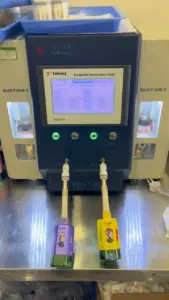
FiHP invited me to look at the production workflow behind the model. I approached it as a visitor interested in the product I would receive, rather than the number of devices moving through the room. The factory footage accompanying this article records part of that workflow.
What the production line made me notice
The camera begins with devices arranged in transparent trays before moving along a room of workstations. Several colours are visible, and people handle products at successive benches. It is a useful change of perspective: a finished vape is also something that must be identified, handled and passed between operations.
I found myself looking for the link between a device and its eventual flavour configuration. Colour makes a tray easy to scan, but colour alone does not establish what is inside. For a customer, the important connection is between the selected six-flavour group, the device and the retail label.
The short production clip gives that question a setting. It does not show every internal operation, and I would not use it to claim that every unit has undergone a particular taste test.
How do multi flavour vapes work in the 600K 6in1?
FiHP’s product diagram identifies six independent e-liquid tanks and a switchable mouthpiece. The current 600K 6in1 product information describes six independent flavour selections. Together, those details describe a selection system with separate liquid storage, rather than an instruction to mix six liquids into one reservoir.
That distinction matters. If a device stored different liquids together, selecting a position would not recover their original separation. Separate tanks give the design a way to keep the stored flavours distinct. The selector then needs to bring the intended flavour into use.
A diagram is helpful for understanding the arrangement, but it is not a complete airflow drawing. It does not by itself establish which parts of the vapour path are shared, how much vapour remains after a draw, or whether a user will notice a transition between flavours.
My answer to the headline question is therefore specific: the 600K 6in1 is described as keeping its liquids in separate tanks. A guarantee that every flavour change will be completely free of a lingering taste would require a switching test, not just a photograph of the device.
Separate liquid and a lingering taste are different questions
When a customer says that two flavours “mix”, they may mean two different things. One is liquid physically entering another liquid’s storage space. The other is noticing something of the previous flavour during a change. These should be investigated separately.
Perceived taste can also carry over from what a person has just tasted. That makes a casual comparison less useful than it first appears. To examine switching properly, I would keep the device setting and draw pattern consistent, note the order of the flavours, and record the first draws after each change.
I would also separate an immediate transition from a persistent problem. A brief impression after changing flavour is a different observation from repeatedly selecting one position and receiving another taste. Neither observation should be described as a proven defect without checking the device and its instructions.
The flavour group matters as much as the selector
The 600K 6in1 order options contain complete groups of six names. One listed group combines Strawberry Watermelon, Watermelon Ice, Red Bull, Strawberry Kiwi, Blueberry Ice and Lemon Lime. Selecting that group means choosing the combination, not buying six individually configurable dropdown options.
This is a practical detail I would check before ordering. I would review the ordering FAQs before confirming an assortment. A device can offer six choices while still including a flavour you do not want. Read the full group, then choose the listed nicotine option separately. An outer colour or a favourite name at the start of the group is not enough to identify the full configuration.
General ordering options such as Mixed Flavours or Tell Us Flavours need a clear agreement about what will be supplied. For a small batch, I would keep the agreed combinations in the order record rather than leave the interpretation until the parcel arrives.
Three questions I would use to assess a multi-flavour device
- Can I identify the selected flavour? The selector indication, instructions and supplied group should make the choice understandable.
- Is the flavour change repeatable? Compare the same change more than once under similar use, rather than relying on a single impression.
- Does the supplied combination match my order? Compare the six-name group and nicotine option with the packaging and order record.
The factory visit made me pay more attention to identification and consistency. Attractive colours can show a range; customers need the correct product, the correct combination and a selector they can understand. If a configuration remains unclear, I would ask FiHP to confirm the combination before placing an order.
What I would check before choosing the 600K
A 6in1 format is most relevant if you want several flavour choices within one device and are comfortable selecting a complete group. If you only want one specific flavour, the presence of five others is not automatically a benefit.
Before ordering, I would compare the actual options and check the supplied instructions, rather than infer the configuration from a device colour.
The useful takeaway from this visit is not a blanket promise about taste. It is a clearer buying question: does the design separate the stored liquids, and does the flavour-switching experience meet your expectations? The product information helps answer the first part. A consistent, recorded comparison is how I would judge the second.